Does Your Cat Watch TV? Welcome to the Wonderful World of Cat Television
What You'll Find In This Article
- Why cat TV is a product of modern technology — and couldn't really have existed before it
- What the science says about what cats actually see on screen
- Whether it's genuinely good for them — and when it isn't
- The best channels to try, and the one safety note worth knowing
Don’t sit so close, you’ll get square eyes! This was the standard ‘mum warning’ as we sat in a semi circle in front of the TV after school. No scientific basis whatsoever of course, and surprise, neither I nor my friends have square eyes.
The warning has evolved with the technology. Where once it was square eyes, now it's hunchbacks, protruding eyes and claw thumbs from doom scrolling, the children of the future, apparently, will be born physically pre-adapted for their devices.
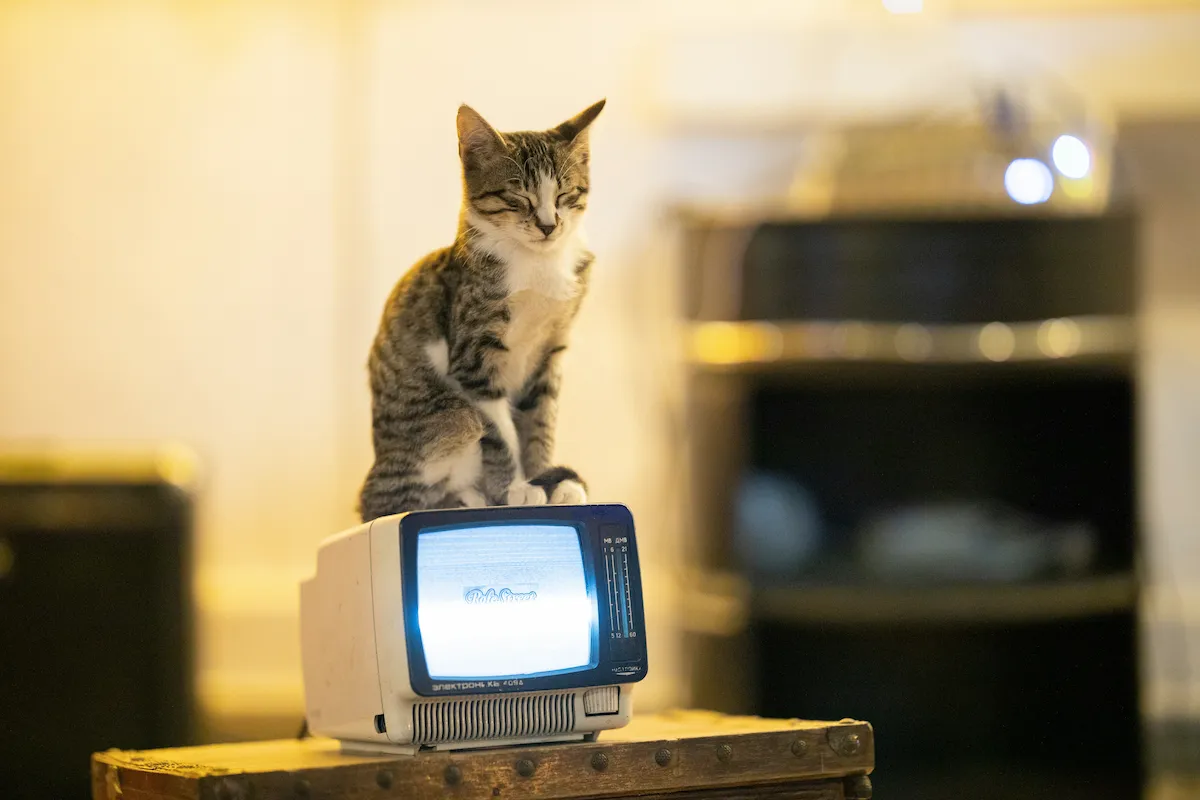
The flat screen revolution isn’t a human only phenomenon. Cats are hooked too. Whether we will start seeing saucer eyed moggies with opposing thumbs in the near future, only the future will tell.
Cat TV is a corner of YouTube where channels are dedicated entirely to a cat only audience and it is massive. Paul Dinning used to spend his days filming birds in the Cornwall countryside in the hope that like minded nature lovers would appreciate his videos. Disappointed with a low view count he retitled the content to ‘videos for cats’ and is now one of the most prolific and widely watched with a huge subscriber base of 828k and a staggering 673,000,000 views (yes, six hundred and seventy three MILLION). His close up videos of birds and other wildlife have cats transfixed.
Paul isn’t the only one, there are many Cat TV channels on YouTube, from ‘Birder King’ who shows 24/7 live videos of wildlife in Canada (200,000,000 views) to ‘Relax My Cat’ where soothing music is played over videos of fish swimming in a pool, cows in a field, cats gently sleeping (337,000,000 views). ‘Cat Entertainment’, started by Charlotte Pugh as a way to keep cats entertained and help people become better cat owners produces original videos. Often animated with music, some reminiscent of computer games for young children, are not just made with a camera in the garden but are produced with imagination and artistic skill.
Cats are hunters, their eyes and reflexes tuned for detecting movement with precision, a millisecond slower and they might miss out on a mouse supper. They process visual information much faster than humans, meaning older televisions, the big boxes that nearly gave me square eyes in the 1980’s and 90’s, were more of a strobe light to cats. Modern flat screens changed that, the faster visuals and higher refresh rates produce a stable picture for cat’s visual system. The cat TV phenomenon exists only because technology does.
A cat's colour vision is limited, blues and greens are fine but reds and oranges are grey and muted, it is instead the highly sensitive awareness of movement stimulating their hunting instincts that draws cats to the screen. But is it simply movement or is it what is moving and how? A study by Queen’s University Belfast where 125 shelter cats were observed watching different types of visual content showed, rather embarrassingly for us, that humans on screen ranked roughly as interesting as nothing at all. Birds, fish and mice, their natural prey, were the clear winner. The cat's focus was on the prey's natural behaviour rather than random movements. Not all engaged but those that did responded to something meaningful rather than just light and colour.
It would be reasonable to assume that if cats watch television, dogs do too. Indeed, they do, but in a completely different way, and for different reasons.
In 2025 a study was carried out by researchers at Auburn University led by Jeffrey Katz, a professor of psychological sciences. Katz said he set out to answer a simple question — "do dogs really watch it or not? And I was just curious. When I looked into it, we just didn't really know a lot.”
The study was published in Scientific Reports and surveyed over 450 dog owners and found that dogs do genuinely engage with screens but that personality is the decisive factor. Excitable dogs track moving objects across the screen. Anxious dogs react to background sounds, a doorbell, a car, another dog barking somewhere off camera. Sporting and herding breeds are significantly more likely to be engaged viewers than other types. Older dogs tend to lose interest entirely.
The content preferences also differ sharply from cats. Dogs respond primarily to other animals on screen, other dogs mostly, and are far less interested in the kind of small prey footage that captivates cats. Where a cat will sit focused and still watching a bird at a feeder, a dog is more likely to bark and paw at it.
Perhaps the most revealing thing is that dogs may be watching partly because you are. Researchers noted that the social dimension of television viewing, sitting with their owner, sharing attention, being part of whatever is happening, appears to be a genuine factor in whether a dog engages with a screen at all.
Leave a dog alone with the television on and many will ignore it entirely. Sit down next to them and suddenly the screen becomes interesting.
The screen, for a cat, is a window into a world of things worth catching. Dogs watch television more as companions, socially, reactively, with one eye on what's on screen and one eye on whether you're still there.
They are, in the end, doing what they've always done. The cats are hunting. The dogs are keeping you company.
For the millions of indoor cats in the UK, Cat TV YouTube channels are perhaps part of the antidote for the lack of hunting that their environments can’t provide. Nothing can replace on its own the mix of interactive play, window gazing and other stimulation that an indoor cat needs, but the flat screen certainly adds to it.
Vet and animal behaviour specialist Dr Rebecca MacMillan puts it plainly: cat TV is more than likely fine in moderation, with no evidence of harm to eyesight or health, and can provide real mental stimulation as long as it supplements rather than replaces interactive play. A cat watching birds on YouTube for twenty minutes while you're at work is enrichment. A cat watching for six hours instead of being engaged with toys and human interaction is not being well served, however much they seem to enjoy it.
There is something quietly wonderful about the fact that a man in Cornwall films garden birds for an audience that will never subscribe, never comment, and will occasionally try to climb inside the television to get at whatever just flew past. Paul Dinning didn't set out to make cat television. He stumbled into it by accident, retitled his videos, and now has 673 million views. His cats, presumably, have no idea.
The square eyes warning turned out to be nonsense. Whether the same will be said one day about saucer-eyed moggies with opposing thumbs — well. Only the future will tell.